
Hardcore off-road recovery gear is not defined by the biggest number printed on the package. A dependable recovery system combines vehicle-rated recovery points, correctly sized ropes or winch equipment, compatible connectors, and a recovery plan appropriate for the terrain.
The most important rule is simple: the complete recovery system is limited by its lowest-rated component. That includes the vehicle attachment point, receiver hitch, recovery block, shackle, rope, winch line, and every other load-bearing component.
Quick Comparison: Which Recovery Tool Does What?
| Recovery component | Best use | Main advantage | Main limitation |
|---|---|---|---|
| Kinetic recovery rope | Mud, sand, snow, and other rolling recoveries | Stretch builds energy progressively and can reduce the initial shock compared with a rigid strap | Requires space, two vehicles, proper technique, and rated attachment points |
| Winch | Controlled pulls on rocks, slopes, ledges, or confined trails | Precise, slow pulling force without a second recovery vehicle | Requires a suitable anchor, electrical capacity, rigging knowledge, and line management |
| Soft shackle | Connecting rope or line to smooth, compatible recovery points | Lightweight, easy to store, and less damaging to painted surfaces | Vulnerable to cuts, burrs, heat, and abrasive edges |
| Steel bow shackle | Connecting to compatible recovery eyes and hardware | Durable and abrasion resistant | Heavy and potentially hazardous if improperly rigged |
| Receiver recovery block | Creating a recovery interface at a properly rated receiver | Provides a purpose-built connection for a soft or steel shackle | The receiver, hitch mounting, block, pin, and shackle must all be appropriate for recovery |
| Recovery ring | Winch redirects and mechanical-advantage rigging | Lighter than many traditional pulley blocks and compatible with synthetic line when properly configured | Not a substitute for a kinetic rope, winch, or rated recovery point |
These tools complement one another. A kinetic rope cannot replace a shackle, and a shackle cannot replace a rated vehicle recovery point.

What Defines Hardcore Off-Road Recovery Gear?
Serious recovery equipment should meet five standards.
1. A secure, vehicle-rated attachment point
Recovery forces must enter the vehicle through a point designed and installed for that purpose. Do not attach a recovery rope or winch line to bumper sheet metal, suspension components, tie-down loops unless the vehicle manufacturer approves them for recovery, or an ordinary tow ball.
A tow ball can become a high-speed projectile if it fails under a recovery load.
2. Published, understandable strength information
Look for clearly identified ratings and learn what they mean:
-
Minimum breaking strength or minimum tensile strength describes the force at which a new component is expected to fail under specified test conditions.
-
Working load limit is the manufacturer’s stated maximum load for normal service under defined conditions.
-
Vehicle recommendation identifies the vehicle-weight range for which a rope or other component is intended.
These figures are not interchangeable. Never convert a break-strength figure into your own working load limit unless the manufacturer supplies the applicable design factor and instructions.
3. Compatible components
A strong rope connected to the wrong shackle or an unrated mounting point does not create a strong recovery system. Check:
-
Receiver size and rating
-
Recovery-block rating
-
Shackle type and dimensions
-
Rope or winch-line specifications
-
Vehicle recovery-point instructions
-
Side-loading restrictions
-
Manufacturer inspection and retirement criteria
Agency 6’s 2-inch aluminum Recovery Hitch Shackle Block, for example, is listed with a 13,000-lb WLL and accepts a 3/4-inch screw-pin shackle. Its product instructions also emphasize using the lowest WLL in the system as the maximum allowable load. See the 2-inch Shackle Block.
4. Protection from abrasion and damage
Synthetic equipment is strong for its weight, but abrasion can reduce that strength. Soft shackles should contact smooth, rounded surfaces—not sharp recovery tabs, damaged metal, or rough castings.
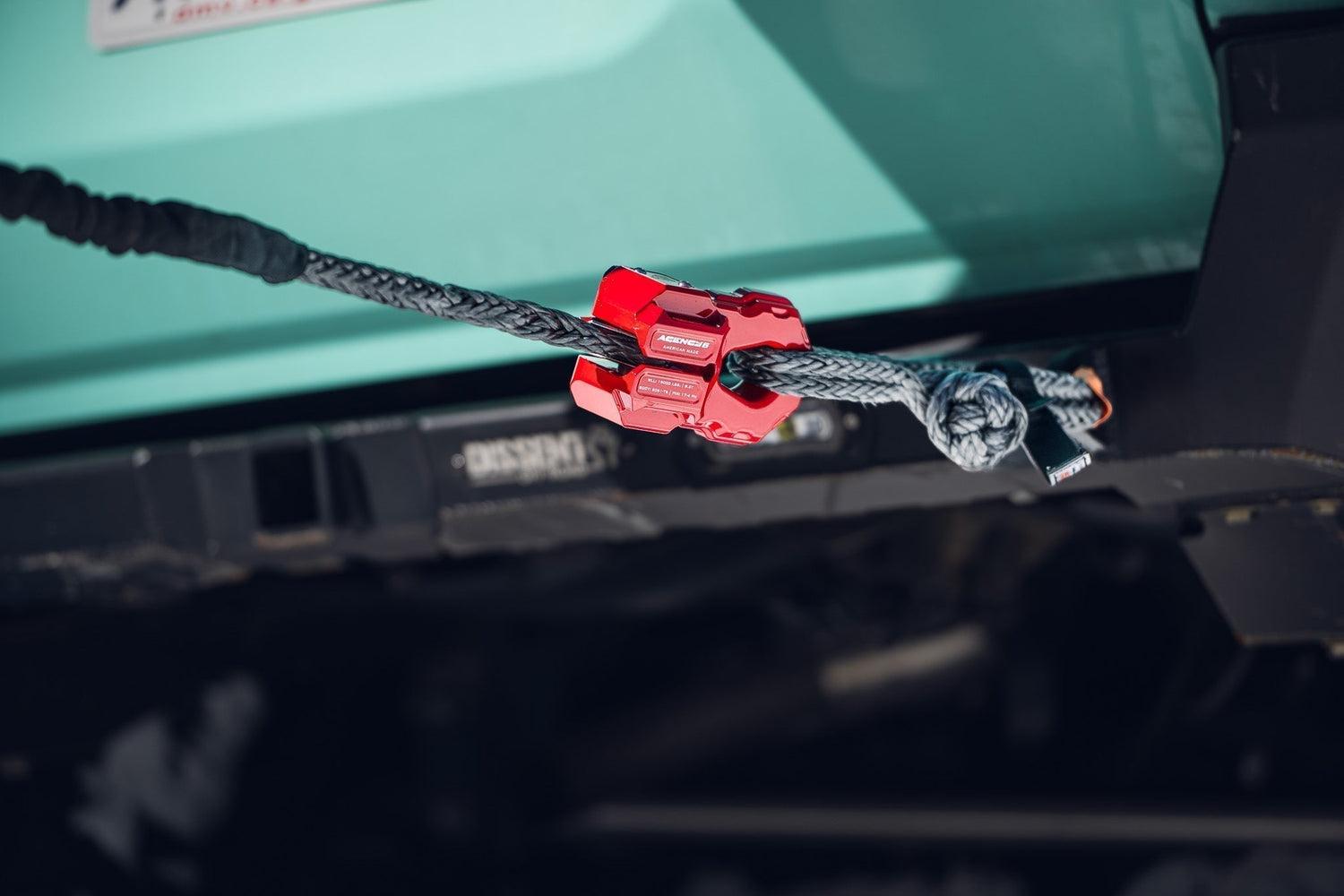
Agency 6’s Soft Shackle Recovery Block for a 2-inch receiver is CNC-machined from 6061-T6 aluminum with a smooth, oversized opening intended to reduce wear on synthetic shackles. Agency 6 publishes a 19,000-lb WLL for the block, while warning that the lowest-rated component still governs the complete setup. Review the Soft Shackle Recovery Block.
5. A defined role in the recovery plan
Every item in the bag should solve a specific problem. More pieces do not automatically make a better kit. A useful kit covers the recoveries the vehicle and driver are likely to encounter.

Kinetic Rope vs. Tow Strap: What Is the Difference?
A kinetic recovery rope is designed to stretch under load. During a properly executed rolling recovery, that stretch stores energy and releases it progressively to help move a stuck vehicle.
A conventional low-stretch tow strap is intended for steady towing or controlled pulling—not a high-energy kinetic recovery. Using a low-stretch strap for a running start can create severe shock loads on vehicles, attachment points, and occupants.
Agency 6’s 1-inch Yankum rope uses double-braid nylon and a polymeric coating intended to resist UV exposure, water, staining, and abrasion. The listed 33,500-lb figure is its minimum tensile strength, and Agency 6 specifies a 6,700–11,200-lb vehicle range. The product page recommends a 7/16-inch soft shackle or 7/8-inch hard shackle.
Even with correctly sized equipment, use the least energy necessary. Do not treat rope stretch as permission for a high-speed pull.
When Is a Winch the Better Tool?
Choose a winch when the recovery requires control rather than momentum. Common examples include:
-
A vehicle hung up on rocks
-
A steep climb or descent
-
A narrow trail with little run-up room
-
A rollover-stabilization situation
-
A solo vehicle with a suitable anchor
-
A recovery where sudden movement could cause additional damage
Winch rigging may include a tree-saver strap, recovery ring, soft shackles, line damper, and properly rated anchor equipment. A recovery ring can redirect synthetic winch line or help create mechanical advantage, but only when the ring, soft shackle, line, anchor, and winch are used according to their manufacturers’ instructions.
Never use a kinetic rope as a winch-line extension unless its manufacturer expressly approves that configuration.
Soft Shackles vs. Steel Shackles
Neither style wins every recovery.
Choose a soft shackle when:
-
The attachment surface is smooth and rounded
-
Low weight matters
-
You want to avoid metal-to-metal contact
-
The shackle is protected from sharp edges and abrasion
Agency 6 lists its 7/16-inch soft shackle with a 45,500-lb minimum break strength. As with the kinetic rope, that is a break-strength specification—not permission to exceed the WLL of the receiver, recovery block, or vehicle attachment point.
Choose a steel bow shackle when:
-
The connection point is compatible with a screw-pin shackle
-
Abrasion resistance is more important than weight
-
The shackle can align with the direction of pull
-
Its body and pin fit without binding
Agency 6’s 3/4-inch D-ring shackle carries a published 4.75-ton—or 9,500-lb—WLL and a stated 5:1 design factor. The body is 1045 carbon steel and the pin is 40Cr alloy steel. Review the 3/4-inch D-ring specifications.
Avoid side-loading a bow shackle unless its manufacturer specifically supplies a reduced side-load rating and permits that use.
What Is the Correct Way to Use a Receiver Hitch for Recovery?
Use a purpose-built receiver recovery block that matches the receiver size and is retained by the correct hitch pin.
The hitch pin holds the recovery block inside the receiver. It is not the intended surface for attaching a kinetic rope or soft shackle. Do not loop recovery gear around a bare pin inside the receiver.
Before using a receiver-mounted recovery point, confirm the ratings and condition of:
-
The receiver hitch and its frame mounting
-
The recovery block
-
The hitch pin
-
The soft or steel shackle
-
The rope, strap, or winch line
Agency 6 offers separate recovery blocks for soft-shackle and steel-shackle configurations. Selecting between them should depend on the connector being used—not color, price, or the largest advertised strength number.

What Should a Complete Off-Road Recovery Kit Include?
A well-rounded kit may contain:
-
Vehicle-rated front and rear recovery points
-
A kinetic rope sized for the vehicle
-
A winch and appropriate winch rigging
-
Two or more compatible soft shackles
-
At least one correctly sized steel bow shackle
-
A receiver-mounted recovery block, if using the hitch
-
A tree-saver strap
-
A recovery ring or pulley system
-
Traction boards
-
A shovel
-
A line damper or recovery blanket
-
Heavy gloves
-
Storage that keeps equipment clean, dry, and organized
Agency 6’s current Vehicle Recovery Kit is built for non-winch recoveries. It includes a 2-inch Shackle Block, 5/8-inch hitch pin, 3/4-inch D-ring, two 7/16-inch soft shackles, a 7/8-inch-by-20-foot kinetic rope, strap wrap, and canvas bag. Agency 6 lists the loaded kit at 15 lb. See the complete kit contents.
That makes it a useful foundation, but it does not replace a winch, traction boards, gloves, or vehicle-specific recovery points.
How to Choose Recovery Gear for Your Rig
Start with the vehicle’s loaded trail weight—not its empty curb weight. Account for passengers, fuel, armor, bumpers, camping equipment, tools, water, and cargo.
Then ask:
-
What does the vehicle manufacturer approve as a recovery point?
-
What is the receiver hitch rated for?
-
Does the rope manufacturer list my loaded vehicle weight?
-
Are every shackle and recovery block compatible?
-
Will the rig be traveling alone?
-
Is the expected terrain better suited to traction, kinetic recovery, or winching?
-
Has every participant practiced the procedure before the recovery becomes urgent?
There is no universal “best” recovery setup. A light rock crawler, full-size overland truck, and heavily loaded van require different equipment and techniques.
Recovery Safety Checklist
Before applying load:
-
Stop and assess the vehicle, terrain, and attachment points.
-
Establish one recovery leader and one communication method.
-
Clear unnecessary people from the recovery area.
-
Inspect ropes, shackles, winch line, pins, and mounting points.
-
Confirm that every component is compatible and correctly installed.
-
Keep spectators well away from the line of pull.
-
Use the minimum force necessary.
-
Stop immediately if equipment shifts, binds, frays, deforms, or makes unusual sounds.
-
Inspect all equipment again before returning it to storage.
When the recovery exceeds your training, equipment, or ability to control the scene, stop and call a qualified recovery professional.
Final Verdict
The best hardcore off-road recovery gear is not simply the strongest individual component. It is a matched system built around the vehicle’s loaded weight, approved recovery points, terrain, and recovery method.
A kinetic rope is valuable for suitable rolling recoveries. A winch provides control in technical terrain. Soft and steel shackles each solve different connection problems. Receiver recovery blocks create a purpose-built interface when the receiver and its mounting are appropriate.
Agency 6’s recovery blocks, shackles, kinetic ropes, and non-winch Vehicle Recovery Kit provide useful examples of how published specifications can guide equipment selection. The deciding number, however, is always the rating of the weakest applicable component.
Frequently Asked Questions
What is the difference between break strength and working load limit?
Break strength describes an expected failure threshold under specified testing. Working load limit is the manufacturer’s maximum permitted service load under defined conditions. Do not treat them as equivalent.
Can I attach a recovery rope directly to a hitch pin?
No. Use a compatible, purpose-built receiver recovery block retained by the correct hitch pin. Do not loop a rope or soft shackle around a bare pin.
Can a kinetic rope replace a winch?
No. A kinetic rope uses vehicle movement and stored energy. A winch provides slow, controlled mechanical pulling. Terrain and available space determine which tool is appropriate.
Can I use a tow ball as a recovery point?
No. A tow ball is not designed for off-road recovery shock loads and may become a dangerous projectile if it fails.
Should I carry both soft and steel shackles?
Yes, provided each is rated, inspected, and compatible with the intended attachment points. Soft shackles work best on smooth, rounded surfaces; steel shackles suit compatible hard recovery eyes and resist abrasion better.
How should I size a kinetic rope?
Follow the rope manufacturer’s stated vehicle-weight range using the vehicle’s actual loaded trail weight. Do not size a rope solely by its advertised break strength.
Recovery work is inherently hazardous. Follow the vehicle and equipment manufacturers’ instructions. This article is educational and is not a substitute for hands-on recovery training.